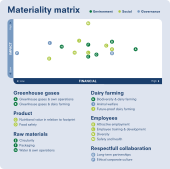
Double materiality assessment
In 2025, we conducted a new DMA at group level, after reporting in 2024 over the previous DMA which dated from 2023. Royal A-ware's DMA-team, comprising the Director ESG, Head of ESG, ESG officer and Manager Risk, carried out the DMA, which was validated by the Sustainability Steering Committee and endorsed by the Management Board. The DMA process consisted of seven phases, spanning from the context analysis to the finalisation of the DMA.
The goal of the context analysis was to gain a comprehensive understanding of the IROs that may be relevant to our company. It involved an analysis of the external environment, including regulatory, market, and societal and environmental developments, a peer analysis to assess what material topics similar companies in the dairy and transport sectors report on, and a value chain analysis to identify where sustainability matters are likely to arise due to the nature of our operations and value chain activities. The context analysis resulted in a longlist of sustainability topics (step 1).
The DMA-team assessed each topic on the longlist for its relevance, sharing its suggestions with the Sustainability Steering Committee. The Sustainability Steering Committee subsequently provided its recommendations, resulting in a shortlist of topics (step 2).

Following Impacts, Risks and Opportunities are defined. We determined the financial materiality scores in collaboration with the Finance department and the impact materiality scores in collaboration with a task force and the DMA-team.
-
Impacts
The severity of impacts was assessed based on three equally weighted criteria: scale, reflecting the extent of positive or negative effects on people or the environment; scope, indicating the number of affected stakeholders or the geographical reach of environmental impacts; and irremediability, referring to the degree to which negative impacts can be reversed. For potential impacts, likelihood, defined as the probability of occurrence, was assessed as an additional parameter. All criteria were rated on a five-point scale, with higher scores indicating greater impact or probability. The severity score for actual impacts is calculated as the average of scale, scope, and irremediability. For potential impacts, the final score reflects the average of severity and likelihood. -
Risks and Opportunities
Sustainability-related risks and opportunities were evaluated based on likelihood and magnitude. Likelihood represents the probability of occurrence, while magnitude reflects the potential impact in terms of strategic relevance and financial implications. Due to the inherent uncertainty in estimating monetary values for sustainability-related scenarios, quantitative analysis was complemented by qualitative assessments. Both criteria were assessed on a five-point scale and weighted equally in the overall evaluation.
In subsequent roundtable sessions with employees from all divisions of Royal A-ware, we asked participants to provide feedback on the updated and scored list, including whether they recognised and agreed with the scoring outcomes (step 3 and 4).
The input from these sessions resulted in a final proposal (including a determination of the threshold). The threshold was established to ensure sufficient focus, acknowledging that not every possible topic can be addressed, while remaining aligned with stakeholder expectations. The final threshold (3.3 on a scale of 5) reflects a comprehensive evaluation that was validated by the Sustainability Steering Committee and subsequently discussed with key stakeholders (step 5 and 6). The DMA was approved by the Sustainability Steering Committee and the Management Board in September 2025 (step 7).