Water & own operations
Royal A-ware identified 'water & own operations' as a material topic under the raw materials pillar during its DMA. Water is an essential resource for our cheese, dairy and tapas production processes. However, external factors such as population growth and climate change have put increasing pressure on its availability. We therefore commit to the responsible use of water in our production processes by minimising consumption and reusing where possible.
Impacts, risks and opportunities
Royal A-ware has screened its assets and activities, incorporating the insights into the DMA process. The DMA subsequently resulted in the following material IROs related to water consumption:
Impact
Potential negative impact on water availability due to multiple sites being classified as industrial large users.
Risks
-
Risk of increased costs due to rising freshwater prices as a result of scarcity or government intervention.
-
Risk of stopping or reducing production due to temporary unavailability or limited availability of fresh water (e.g., in times of drought) or contamination (e.g., non-purifying substances such as PFAS / hormones).
Water Risk areas
Before drafting the water policy, the situation at sites in areas of water stress was investigated. This showed that water filtration in particular is a major cause of water stress. For the locations in Belgium and the Netherlands where water stress is an issue, we are therefore investigating additional measures to capture, treat and reuse excess rainwater. Thus, we not only reduce dependence on surface and piped water, but also the risk of flooding.
Our approach
As part of our commitment to using water responsibly, we have developed a water policy focused on sustainable water withdrawal and management within our production facilities. The managing directors are responsible for this policy. Our water policy covers exclusively water use at our production facilities since the impact of water use at our offices is minimal. There are no known instances of local communities being adversely affected by water consumption related to Royal A-ware’s operations. Consequently, Royal A-ware has not engaged in consultations with local communities.
Water policy
At the end of 2024, Royal A-ware carried out a baseline measurement at all production sites. Based on this measurement, we set a target and developed a policy, which was implemented in 2025. Our water policy prioritises facilities in water-scarce areas, followed by major water-use sites and finally smaller sites. For each individual site, we identify opportunities for reducing water consumption, either by increasing process efficiency or by enabling reuse. The latter approach involves the recirculation of water (e.g., water is kept within a closed circuit system for cooling), the reuse of water (e.g., water derived from milk is returned to the production cycle), and recycling of water (e.g., water from food processing activities is treated and used in other applications).These measures support the long-term availability of water resources, reduce pressure on aquatic ecosystems and protect them.
|
Water performance (m3) |
2025 |
2024 |
|---|---|---|
|
Total tap water consumption |
2,016,292 |
1,943,448 |
|
of which total tap water consumption in m3 in areas at water risk, including areas of high-water stress |
257,641 |
252,005 |
|
Waterintensity: total tap water consumption in its own operations in m3 per million EUR net revenue as stated in note 19 of the financial statements |
456 |
510 |
Objectives and actions
Royal A-ware aims to use water responsibly by reducing consumption and reusing as much as possible. We achieve this through ongoing actions which are embedded in our ongoing operational and continuous improvement processes:
-
Exploring ways to increase the quality of wastewater so that it is as clean as possible.
-
Exploring end-of-pipe wastewater treatment techniques to further reduce the environmental impact of wastewater discharges. By doing so, we take a proactive approach to potentially stricter regulations and higher costs due to wastewater discharge.
-
For the locations in Belgium and the Netherlands where water stress is an issue, we are investigating additional measures to capture, treat and reuse excess rainwater.
-
The Management Board will allocate the resources (financial and manpower) for actions needed for the reduction of water use. Allocation of resources is part of our regular course of business and thus specific allocation is not applicable.
-
At Royal A-ware, we focus our water reporting on tap water withdrawal, as this is the most consistent and relevant source of water use within our operations. Our production processes involve significant internal water reuse, particularly water recovered from milk. For example, at our Heerenveen site, water is extracted from whey—a by-product of cheese production that consists of about 93% water. This reclaimed water is reused in cheese-making and for cleaning equipment, amounting to more than 3 million litres per day. Due to this extensive reuse, it is not possible to establish a fully accurate and closed overview of all water flows. Based on these insights, Royal A-ware has chosen to report on tap water use as the most meaningful metric. And as part of our sustainability approach, we aim to lower water consumption. Focusing on tap water withdrawal allows us to direct efforts where we have the greatest impact.
Actions in 2025
Other then more general actions to reduce water usage, there were no specific actions to steer at a 1% reduction at all production locations. The data of 2024 and 2025 gives us now specific insights to reduce water usage at the different locations (locations which were operational as part of the Royal A-ware in 2024 and 2025).
Targets and achievements
Royal A-ware's water policy and targets are aligned with the Dutch government’s policy for reducing the use of water. The National Action Plan for Drinking Water Conservation requires wholesale business users to reduce water consumption by 20% by 2035 compared to a 2016-2019 baseline period.
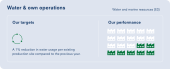
Since Royal A-ware does not have a baseline measurement for the 2016-2019 period and has grown through multiple acquisitions, we cannot directly adopt the government's target. However, we are committed to achieving at least the same 1% annual reduction for each production site using 2024 as our baseline.
Water consumption
The total tap water consumption and consumption of water in areas at water risk, including areas of high-water stress show an increase compared to 2024. This is mainly due to the acquisition of The Dairy Food Group. 7 out of 20 production locations have realised an 1% reduction of water usage.
The changes in water usage differ quite a lot and 2026 will be used to get a better understanding in these fluctuations and actions will be tailored according to the findings.